BreathEaseX Reviews: Publishes 2026 Ingredient Research-Based Look at the Daily Spray Formulated for Breathing Comfort
Reference file lists each ingredient in the BreathEaseX oral spray and its CardioEaseX companion capsule alongside the
Press Release Disclaimer: This is a press release distributed through the XPR Media network. It has not been independently verified by our newsroom.
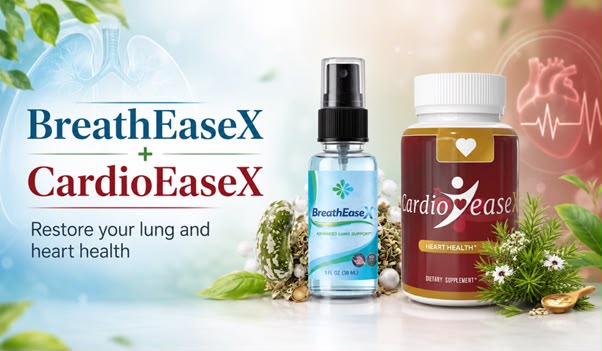

Reference file lists each ingredient in the BreathEaseX oral spray and its CardioEaseX companion capsule alongside the published study behind it, and states which populations those studies examined
Wilmington, DE, November 4, 2026 – BreathEaseX, the maker of a once-daily oral spray supplement, has published an ingredient research file that names every active ingredient in the spray and in its companion capsule, CardioEaseX, and pairs each one with a peer-reviewed study or review. The file also states, for each study, which population was examined and how that differs from use of the finished products, none of which have been clinically tested as complete formulas.
The file lists six ingredients in the BreathEaseX spray: N-acetylcysteine (NAC), manuka honey graded MGO 400+, quercetin, olive leaf extract, vitamin D3 and L-theanine. It lists four in CardioEaseX: coenzyme Q10 (CoQ10), hawthorn berry, L-carnitine and magnesium. The company says each ingredient is disclosed individually on its labels rather than grouped in a proprietary blend.
Official Website: www.breatheasex.com
“People reading reviews of supplements are often given a list of benefits and no way to check them,” said Kevin Shaw, Media Relations Manager at BreathEaseX. “We decided to publish the studies themselves, and to say plainly who was in each one. Most of this research was done in people with diagnosed conditions, using a single ingredient. That isn’t the same as an adult using our spray, and we’d rather readers know that up front.”
Why the Company Published the File
BreathEaseX said the file responds to the questions that appear most often in BreathEaseX reviews and in messages to its support team: what is in each product, what the research on those ingredients shows, and whether that research was conducted on BreathEaseX itself. The short answer to the last question, the company said, is no. Every study cited in the file was conducted independently on individual compounds.
The release of the file also comes amid wider public attention to lung health. The American Lung Association’s 2026 “State of the Air” report, published in April, found that 44 percent of Americans, about 152.3 million people, live in places that received a failing grade for ozone or particle pollution. Separately, a 2023 analysis by the Centers for Disease Control and Prevention estimated that 14.2 million U.S. adults, or 6.5 percent, had physician-diagnosed chronic obstructive pulmonary disease (COPD) in 2021.
BreathEaseX said it cites those figures as context for public interest in respiratory health, not as evidence about its products. The company does not claim that BreathEaseX or CardioEaseX counters the effects of air pollution or addresses COPD or any other condition. Both products are sold as dietary supplements, and the FDA does not review dietary supplements for effectiveness before they go on sale.
How the Products Are Used
BreathEaseX is a liquid sprayed into the mouth. The label directs four sprays once a day. CardioEaseX is a capsule, taken as two capsules daily with water, preferably in the morning. The company describes both formulas as stimulant-free and non-GMO. Both products are intended for adults.
BreathEaseX Spray Ingredients and the Research Behind Them
N-acetylcysteine (NAC). NAC is a modified form of the amino acid cysteine that has long been used in clinical settings to thin mucus. A 2015 meta-analysis by Cazzola and colleagues in the European Respiratory Review pooled clinical trials of oral NAC in people with chronic bronchitis or COPD and reported fewer flare-ups among those taking NAC. The trials enrolled people with diagnosed lung conditions and used NAC as a single compound, typically in tablet form, not as part of an oral spray.
Quercetin. Quercetin is a flavonoid, a plant pigment found in onions, apples and many other fruits and vegetables. A 2016 review by Mlcek and colleagues in the journal Molecules summarized research on quercetin’s role in immune and allergic response pathways. Most of that work was conducted in laboratory and animal models, and the review did not evaluate quercetin in a multi-ingredient spray.
Manuka honey MGO 400+. Manuka honey is produced by bees that forage on the manuka bush, native to New Zealand and Australia. It is graded by its methylglyoxal (MGO) content, which is associated with its antibacterial activity. A 2016 review by Carter and colleagues in Frontiers in Microbiology summarized manuka honey’s antimicrobial properties, mainly in wound-care and laboratory settings. The review did not examine manuka honey taken as an oral spray. In BreathEaseX, it also contributes flavor.
Vitamin D3. Vitamin D3 is the form of vitamin D that the skin produces in sunlight and that occurs in some foods. A 2017 systematic review and meta-analysis by Martineau and colleagues in The BMJ, which pooled individual data from 25 randomized trials, found that vitamin D supplementation modestly reduced the rate of acute respiratory infections overall, with the clearest effect in people who were vitamin D deficient at the start. The trials used a range of doses and formats that differ from a spray serving.
Olive leaf extract. Olive leaf extract contains oleuropein, a compound studied for antioxidant activity. A 2010 review by Omar in Scientia Pharmaceutica summarized pharmacological research on oleuropein. That research centers mainly on cardiovascular and metabolic measures rather than lung function, and the company notes that no cited study evaluates olive leaf extract for respiratory use.
L-theanine. L-theanine is an amino acid found mainly in tea leaves. A 2019 randomized trial by Hidese and colleagues in the journal Nutrients examined L-theanine in healthy adults and reported improvements in self-reported stress and sleep measures. The company includes L-theanine for relaxation and states that it does not act directly on the lungs. No cited study evaluates L-theanine for breathing.
CardioEaseX Capsule Ingredients and the Research Behind Them
Coenzyme Q10 (CoQ10). CoQ10 is a compound the body produces to support energy production in cells, and levels tend to decline with age. The Q-SYMBIO trial, published by Mortensen and colleagues in JACC: Heart Failure in 2014, studied CoQ10 added to standard treatment in adults with chronic heart failure over about two years. Its findings apply to that patient group and to the protocol used in the trial, not to general supplementation in healthy adults.
Hawthorn berry. Hawthorn is a flowering shrub with a long history of traditional use. The SPICE trial, published by Holubarsch and colleagues in the European Journal of Heart Failure in 2008, tested a hawthorn extract added to prescribed medication in adults with heart failure. The authors reported that the extract did not significantly change the trial’s main outcome and was well tolerated. The company cites the trial for its size and design, and notes that it does not support a claim of benefit.
L-carnitine. L-carnitine is an amino acid derivative involved in moving fatty acids into cells for energy. A 2013 systematic review and meta-analysis by DiNicolantonio and colleagues in Mayo Clinic Proceedings examined L-carnitine in adults who had already had a heart attack. Its findings relate to that group, not to healthy adults.
Magnesium. Magnesium is an essential mineral involved in many processes in the body, including blood vessel function. A 2016 meta-analysis by Zhang and colleagues in the journal Hypertension pooled 34 randomized trials and found that magnesium supplementation produced a small reduction in blood pressure. The trials used a range of doses and forms, and the effect was modest.
What the Research Does Not Show
The file closes its research section with a statement the company asked to be repeated in full: none of the studies cited was conducted on BreathEaseX or CardioEaseX, and none shows that either finished product produces the results reported for an individual ingredient.
Several of the strongest findings in the file come from people with diagnosed lung or heart conditions who were also receiving medical care. The company states that those findings should not be read as applying to the general adult population, and that its products are not a substitute for treatment of any condition.
“We think a reader is better served by an honest file than a flattering one,” Kevin Shaw said. “If the research on an ingredient is thin for the purpose people expect, the file says so. Hawthorn is a good example. The largest trial we cite didn’t find the benefit its authors were looking for, and we included it anyway.”
Who Should Check With a Doctor First
BreathEaseX advises that adults who have a lung or heart condition, who are pregnant or nursing, or who take prescription medicines should talk with a doctor before using either product. People who take heart, blood pressure or blood-thinning medicines should be especially careful to ask first, because hawthorn and CoQ10 can interact with some of those medicines. People who use a prescribed inhaler or other breathing treatment should continue to use it as directed.
Anyone with ongoing shortness of breath, a lasting cough or chest discomfort should be evaluated by a health care professional rather than relying on a dietary supplement.
Product Terms and Verification
The company states that each order is a one-time charge with no subscription, and that both products are covered by a 60-day money-back guarantee from the order date. Refunds require a Return Merchandise Authorization from customer support before any product is returned. Return shipping is the customer’s responsibility, and returned items must arrive within 14 days of the authorization being issued.
BreathEaseX said it is aware of at least one website with a similar name and branding. It advises customers to confirm that they are using the company’s own website, breatheasex.com, and to keep their order confirmation and the lot number printed on each bottle.
Frequently Asked Questions
What is BreathEaseX? BreathEaseX is a once-daily oral spray dietary supplement for adults. It contains NAC, manuka honey MGO 400+, quercetin, olive leaf extract, vitamin D3 and L-theanine.
What is CardioEaseX? CardioEaseX is a companion capsule that contains CoQ10, hawthorn berry, L-carnitine and magnesium. It is taken as two capsules a day.
Has BreathEaseX been clinically tested? No. The research file covers studies on individual ingredients. The company has not published a clinical study on either finished product.
Does BreathEaseX treat COPD or any lung condition? No. BreathEaseX is a dietary supplement and is not intended to diagnose, treat, cure or prevent any disease.
Is the ingredient list a proprietary blend? No. The company states that each active ingredient is listed individually on the label.
Can BreathEaseX be used with prescription medicines? Anyone taking prescription medicines should check with a doctor or pharmacist first. Hawthorn and CoQ10 in CardioEaseX can interact with some heart and blood-thinning medicines.
References
-
Cazzola M, Calzetta L, Page C, et al. Influence of N-acetylcysteine on chronic bronchitis or COPD exacerbations: a meta-analysis. European Respiratory Review. 2015;24(137):451-461.
-
Mlcek J, Jurikova T, Skrovankova S, Sochor J. Quercetin and its anti-allergic immune response. Molecules. 2016;21(5):623.
-
Carter DA, Blair SE, Cokcetin NN, et al. Therapeutic manuka honey: no longer so alternative. Frontiers in Microbiology. 2016;7:569.
-
Martineau AR, Jolliffe DA, Hooper RL, et al. Vitamin D supplementation to prevent acute respiratory tract infections: systematic review and meta-analysis of individual participant data. BMJ. 2017;356:i6583.
-
Omar SH. Oleuropein in olive and its pharmacological effects. Scientia Pharmaceutica. 2010;78(2):133-154.
-
Hidese S, Ogawa S, Ota M, et al. Effects of L-theanine administration on stress-related symptoms and cognitive functions in healthy adults: a randomized controlled trial. Nutrients. 2019;11(10):2362.
-
Mortensen SA, Rosenfeldt F, Kumar A, et al. The effect of coenzyme Q10 on morbidity and mortality in chronic heart failure: results from Q-SYMBIO. JACC: Heart Failure. 2014;2(6):641-649.
-
Holubarsch CJF, Colucci WS, Meinertz T, et al. The efficacy and safety of Crataegus extract WS 1442 in patients with heart failure: the SPICE trial. European Journal of Heart Failure. 2008;10(12):1255-1263.
-
DiNicolantonio JJ, Lavie CJ, Fares H, et al. L-carnitine in the secondary prevention of cardiovascular disease: systematic review and meta-analysis. Mayo Clinic Proceedings. 2013;88(6):544-551.
-
Zhang X, Li Y, Del Gobbo LC, et al. Effects of magnesium supplementation on blood pressure: a meta-analysis of randomized double-blind placebo-controlled trials. Hypertension. 2016;68(2):324-333.
-
American Lung Association. State of the Air 2026. April 2026.
-
Liu Y, Carlson SA, Watson KB, et al. Trends in the prevalence of chronic obstructive pulmonary disease among adults aged ≥18 years — United States, 2011–2021. MMWR. 2023;72(46):1250-1256.
None of these sources mentions, reviews or endorses BreathEaseX or CardioEaseX.
About BreathEaseX
BreathEaseX, founded in 2021 and based in Delaware, develops dietary supplements for adults. Its products are the BreathEaseX oral spray and the CardioEaseX capsule. The company lists each active ingredient individually on its labels and publishes the research references for those ingredients, along with notes on what each study examined. More information is available at breatheasex.com.
Media Contact Kevin Shaw, Media Relations Manager, BreathEaseX Email: support@breatheasex.com Phone: +1 (720) 619-8477 Website: breatheasex.com
1201 N Orange Street Suite #7223, Wilmington, DE, 19801, USA
These statements have not been evaluated by the Food and Drug Administration. These products are not intended to diagnose, treat, cure, or prevent any disease. Individual experiences vary.
Media gallery