DecaQ Reports 108-Qubit FeMoco-Derived Quantum Phase Estimation with a 2.045-Second Full-Pipeline Median
DecaQ.ai, digital quantum computation technology, announced results for a FeMoco CAS(54e,54o) QPE workload executed
Press Release Disclaimer: This is a press release distributed through the XPR Media network. It has not been independently verified by our newsroom.
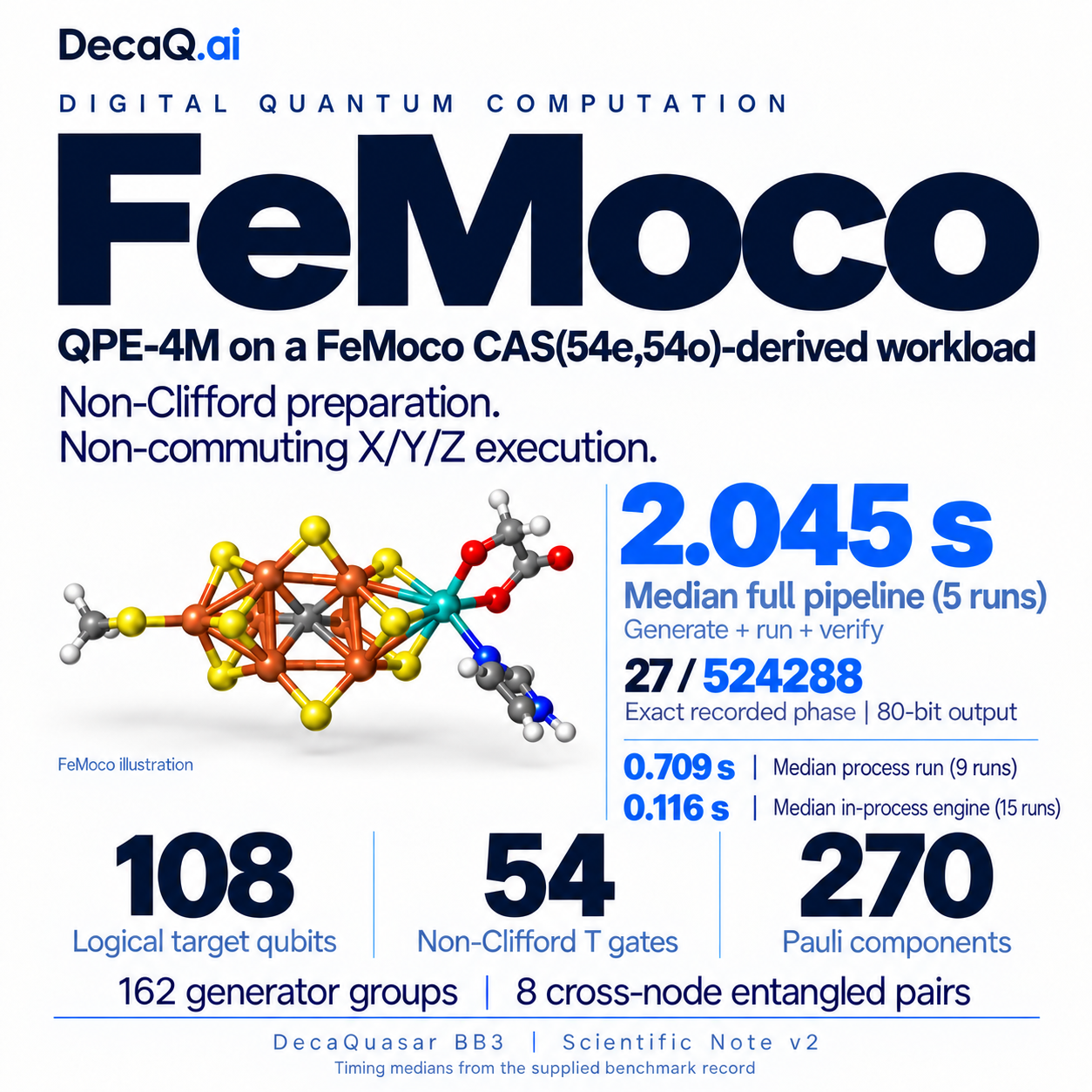

DecaQ.ai, digital quantum computation technology, announced results for a FeMoco CAS(54e,54o) QPE workload executed using its DecaQuasar architecture.
PETACH TIKVA, ISRAEL, September 25, 2026 /EINPresswire.com/ — FOR IMMEDIATE RELEASE
DecaQ Reports 108-Qubit FeMoco-Derived Quantum Phase Estimation with a 2.045-Second Full-Pipeline Median
The QPE-4M workload combines non-Clifford state preparation, cross-node entanglement and non-commuting Hamiltonian execution, with no dense global statevector allocation reported.
September 24, 2026 — DecaQ.ai, a developer of digital quantum computation technology, today announced results for a FeMoco CAS(54e,54o)-derived quantum phase estimation workload executed using its DecaQuasar BB3 architecture.
The company’s scientific report documents 108 logical target qubits, non-Clifford target-state preparation and a Hamiltonian containing non-commuting X, Y and Z Pauli components. The accompanying benchmark records a median full-pipeline time of 2.045 seconds, covering workload generation, execution and verification across five runs.
FeMoco, the iron–molybdenum cofactor found in nitrogenase enzymes, plays a central role in biological nitrogen fixation. Understanding its electronic structure and catalytic behavior is an important research challenge, with potential implications for catalyst design and fertilizer production. FeMoco active-space models have consequently become prominent research targets in quantum computational chemistry.
A workload incorporating superposition, entanglement and non-Clifford preparation
The updated QPE-4M workload uses 270 state-preparation gates, including 54 non-Clifford T gates and a 54-edge cyclic CZ interaction layer.
The prepared state has support over 2⁵⁴ computational-basis components, with exactly 54 electrons represented in every component. The scientific report records eight entangled pair links across the target-node partition and a node-partition Schmidt rank of 256.
The Hamiltonian comprises 162 generator groups, expanding to 270 Pauli components, including 216 anticommuting component pairs. Its execution spans two target nodes and one QPE control node, with 40 Hamiltonian components crossing the target-node partition.
Across 80 QPE precision rounds, the execution record reports:
12,960 generator-group evaluations
21,600 expanded-component evaluations
3,200 cross-node component evaluations
The exact recorded eigenphase is 27/524288, returned as an 80-bit binary string. The execution record reports no dense global statevector allocation and zero materialized global amplitudes.
Runtime measurements with defined boundaries
The supplied benchmark distinguishes three timing measurements:
Measurement Median Runs
Full pipeline: generation, execution and verification 2.045 seconds 5
Process-level execution 0.709 seconds 9
In-process engine execution 0.116 seconds 15
Scientific documentation
The accompanying publication package includes the scientific report, the complete OpenQASM target-state preparation source and a timing appendix. Artifact identifiers connect the benchmark to the workload documented in the report.
The announced result concerns phase evaluation for the specified FeMoco-derived workload. It does not report a full FeMoco ground-state energy calculation. The OpenQASM attachment specifies target-state preparation; the report separately describes the QPE-4M Hamiltonian execution.
About DecaQ.ai
DecaQ.ai develops scaleble digital quantum computation technology – Quantum Power. Within Reach.
DecaQ is digital quantum oracle – not a quantum simulator – Not a state-vector – Not a tensor network, running on general-purpose computing hardware. No QPU – no physical qubits – no cryogenics – No quantum noise.
Its DecaQuasar architecture is designed to execute quantum algorithm workloads through a Digital Quantum Oracle, with an emphasis on deterministic execution and verifiable results.
Gal Rotem
DecaQ
+972546664144 ext.
email us here
Legal Disclaimer:
EIN Presswire provides this news content “as is” without warranty of any kind. We do not accept any responsibility or liability
for the accuracy, content, images, videos, licenses, completeness, legality, or reliability of the information contained in this
article. If you have any complaints or copyright issues related to this article, kindly contact the author above.

Media gallery