China Product Compliance: How to Check CE, RoHS and REACH Requirements Before Production
HONG KONG, HONG KONG, HONG KONG, November 17, 2026 /EINPresswire.com/ -- China Product Compliance: How to Check CE,
Press Release Disclaimer: This is a press release distributed through the XPR Media network. It has not been independently verified by our newsroom.

HONG KONG, HONG KONG, HONG KONG, November 17, 2026 /EINPresswire.com/ — China Product Compliance: How to Check CE, RoHS and REACH Requirements Before Production
This article gives general information only. It is not legal advice. Rules depend on the product, the market and the date, so confirm requirements with a qualified compliance specialist.
Short answer: Check compliance before production starts, not after. First identify which rules apply to your product and market. Then screen the materials in the bill of materials (BOM), test samples at an accredited laboratory, check that the reports really cover your product, and keep the technical documents together. Relying only on a certificate from the supplier is risky, because reports can be out of date, cover a different product, or come from a lab that is not accredited for the test.
What Is the Difference Between CE, RoHS and REACH?
Other markets have their own rules, such as UKCA or UK rules for Great Britain, California Proposition 65 warnings, and FDA rules for some product types. Check the current requirements for each market you sell in.
Does a Supplier’s Certificate Prove the Product Is Compliant?
Not by itself. A certificate or test report is useful evidence, but it needs checking. Common problems include:
The report is old, or the standard it refers to has been updated
It covers one part (for example a plastic housing), not the whole product
The lab is not accredited for that test
The model tested is not the model you are buying
The “CE certificate” is a lab report, which is not the same as CE marking and a Declaration of Conformity
What Should Buyers Verify in a Test Report?
Which laboratory issued it, and is it accredited (for example under CNAS or ILAC) for this test?
Does the report number check out with the issuing laboratory?
Does the test scope match your product, model and materials?
Is the report recent, and does it list the current version of the standard?
Do the samples tested represent what will actually be produced?
Do the production materials match what was tested?
Where possible, confirm with the issuing lab directly.
Who Is Responsible for Compliance?
Responsibility depends on the market and the law. In the EU, for example, the manufacturer, an authorised representative and the importer each have defined duties, and importers must check that the manufacturer has done what is required. In other markets, the importer or seller may be responsible for what they bring to market. In short, a supplier’s promise does not remove your own responsibility as an importer or seller. Ask a compliance specialist what applies to your role.
Non-compliant goods can lead to shipments being held or refused, products being withdrawn or recalled, fines, and marketplace or retailer action. How severe this is depends on the market and the product.
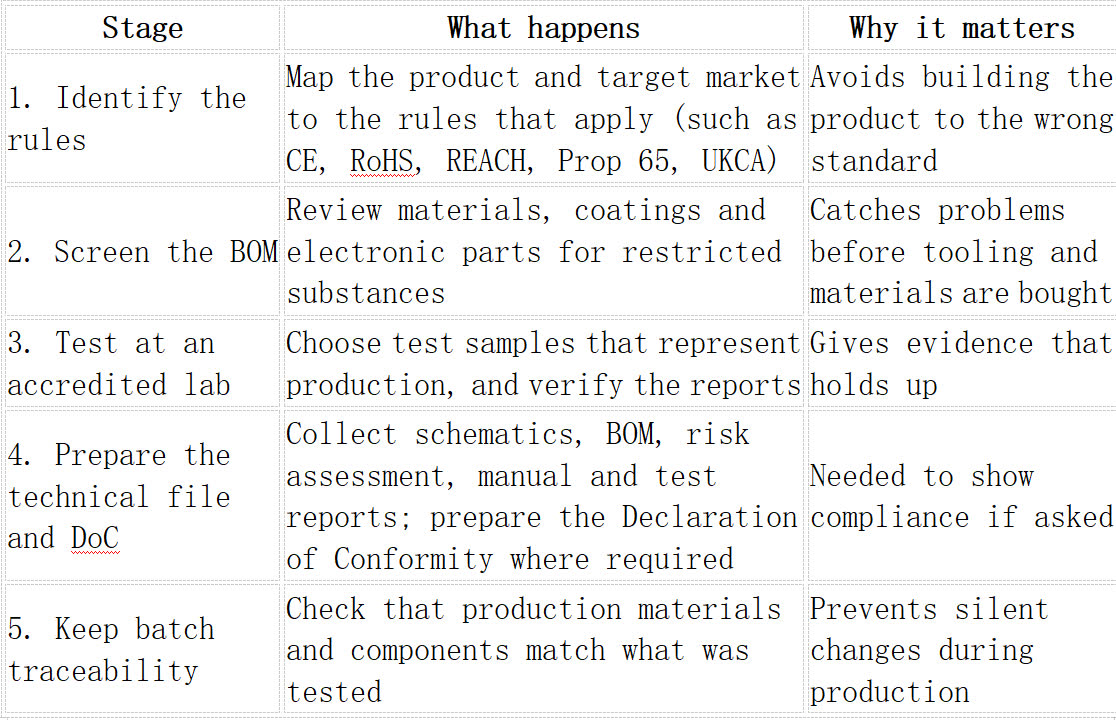
How Can Buyers Check Compliance Before Production?
A practical process has five stages:
What Are RoHS and REACH Checks in Practice?
RoHS. RoHS applies to electrical and electronic equipment. It limits substances such as lead, mercury, cadmium, hexavalent chromium, and certain flame retardants and phthalates. Screening often starts with XRF, which is a quick method for heavy metals. XRF cannot identify all substances (phthalates, for example, need other methods), and screening results may need confirming with further lab tests. Ask the lab which methods it uses.
REACH. REACH includes restrictions on certain substances and the SVHC Candidate List, which is updated regularly. If a listed SVHC is present in a product above 0.1% by weight, there are duties to pass information on to customers, and in some cases to notify the authority. Whether this applies depends on the substance and quantities. Screen materials early, so you can change them if needed.
Prop 65. California Proposition 65 requires warnings for products that expose consumers to listed chemicals above set levels. It is a warning rule, not a ban, but legal action is possible if warnings are missing.
What Should Be in a Technical File?
Product description and intended use
Circuit diagrams, drawings and BOM
Risk assessment
User manual and labeling
Test reports from accredited labs
Declaration of Conformity (where required)
Records that link production batches to tested components
The exact contents depend on the product and the law, so confirm what your product needs.
What Happens If a Product Fails a Lab Test?
Find out why, then fix the cause. Typical steps are to identify the failing material or component, change the material or design with the factory, and test again. Failing early, before mass production, is far cheaper than failing after goods are made.
How Does Sinolinkers Help With Product Compliance?
Sinolinkers helps overseas buyers manage sourcing, production, quality control, compliance coordination and international shipping in China. For China Product Compliance, Sinolinkers coordinates the practical work with the factory, which can include:
Mapping the markets and rules that apply, together with the buyer
Screening the BOM for restricted substances
Coordinating testing at accredited labs such as SGS, TÜV or Intertek, and checking reports with the issuing lab
Collecting and organising documents for the technical file and Declaration of Conformity
Following material and batch consistency during production through multi-stage QC
Sinolinkers is not a certification body and does not issue certificates. Final compliance responsibility stays with the brand owner or importer, and legal questions should go to a qualified specialist. For tracking documents and samples across suppliers, see our guide to a digital SCM solution.
FAQ
Do all products need CE marking?No. CE marking applies only to products covered by specific EU laws. Check which ones apply to your product.
Is a CE test report the same as a CE certificate?No. A test report from a lab is evidence. CE marking is made by the manufacturer on the basis of the applicable rules, with a Declaration of Conformity. For some product types, a notified body must also be involved.
When should I start compliance checks?Before production and ideally during design, so materials and design can still be changed.
How can I tell if a test report is real?Check the lab’s accreditation, the report number with the lab itself, and the scope. Do not rely on the PDF alone.
Does passing one test mean my product is compliant everywhere?No. Different markets have different rules and limits. Check each market you plan to sell in.
Can a sourcing company guarantee my product will pass customs?No. It can help reduce risk by checking materials, tests and documents beforehand, but compliance decisions and responsibility stay with the brand owner or importer.
Starting a product that needs CE, RoHS or REACH checks? Visit sinolinkers.com to talk to the team.
sinolinkers
sinolinkers
Legal Disclaimer:
EIN Presswire provides this news content “as is” without warranty of any kind. We do not accept any responsibility or liability
for the accuracy, content, images, videos, licenses, completeness, legality, or reliability of the information contained in this
article. If you have any complaints or copyright issues related to this article, kindly contact the author above.

Media gallery